

What Does Windows Need To Properly Communicate With And Use The Functionality Of Hardware?
What is an operating arrangement?
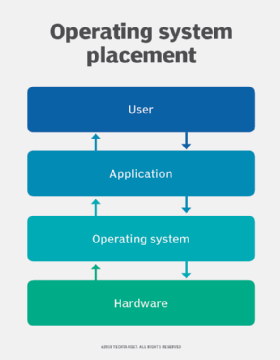
An operating system (OS) is the program that, after being initially loaded into the computer past a boot programme, manages all of the other application programs in a computer. The application programs brand use of the operating system by making requests for services through a defined application program interface (API). In improver, users can interact directly with the operating system through a user interface, such as a command-line interface (CLI) or a graphical UI (GUI).
Why utilize an operating organization?
An operating system brings powerful benefits to figurer software and software development. Without an operating system, every application would need to include its own UI, equally well equally the comprehensive lawmaking needed to handle all low-level functionality of the underlying computer, such every bit deejay storage, network interfaces and then on. Considering the vast array of underlying hardware available, this would vastly bloat the size of every awarding and make software evolution impractical.
Instead, many common tasks, such as sending a network packet or displaying text on a standard output device, such as a display, tin exist offloaded to organisation software that serves equally an intermediary between the applications and the hardware. The system software provides a consistent and repeatable way for applications to interact with the hardware without the applications needing to know any details about the hardware.
As long as each application accesses the aforementioned resources and services in the same style, that organisation software -- the operating system -- tin service well-nigh any number of applications. This vastly reduces the amount of fourth dimension and coding required to develop and debug an application, while ensuring that users can control, configure and manage the system hardware through a mutual and well-understood interface.
Once installed, the operating system relies on a vast library of device drivers to tailor Bone services to the specific hardware environs. Thus, every application may brand a common telephone call to a storage device, just the Bone receives that call and uses the respective driver to interpret the call into actions (commands) needed for the underlying hardware on that specific reckoner. Today, the operating organization provides a comprehensive platform that identifies, configures and manages a range of hardware, including processors; memory devices and memory management; chipsets; storage; networking; port advice, such equally Video Graphics Assortment (VGA), High-Definition Multimedia Interface (HDMI) and Universal Serial Bus (USB); and subsystem interfaces, such every bit Peripheral Component Interconnect Express (PCIe).
Functions of an operating arrangement
An operating system provides three essential capabilities: It offers a UI through a CLI or GUI; it launches and manages the application execution; and information technology identifies and exposes system hardware resources to those applications -- typically, through a standardized API.
UI. Every operating arrangement requires a UI, enabling users and administrators to interact with the OS in order to fix, configure and fifty-fifty troubleshoot the operating system and its underlying hardware. At that place are two primary types of UI bachelor: CLI and GUI.
The CLI, or terminal mode window, provides a text-based interface where users rely on the traditional keyboard to enter specific commands, parameters and arguments related to specific tasks. The GUI, or desktop, provides a visual interface based on icons and symbols where users rely on gestures delivered by human interface devices, such every bit touchpads, touchscreens and mouse devices.
The GUI is most oft used past casual or end users that are primarily interested in manipulating files and applications, such every bit double-clicking a file icon to open up the file in its default application. The CLI remains popular amid avant-garde users and arrangement administrators that must handle a series of highly granular and repetitive commands on a regular ground, such as creating and running scripts to prepare new personal computers (PCs) for employees.
Application management. An operating system handles the launch and management of every awarding. This typically supports an array of behaviors, including timesharing multiple processes, or threads, so that various tasks tin share the available processors' time; handling interruptions that applications produce to proceeds a processor's immediate attending, ensuring there is enough memory to execute the application and its corresponding information without interfering with other processes; conveying out error treatment that can gracefully remove an awarding's processes; and performing memory direction without disrupting other applications or the OS.
An operating organization can besides support APIs that enable applications to utilize OS and hardware functions without the demand to know anything most the low-level Os or hardware country. Equally an example, a Windows API tin can enable a programme to obtain input from a keyboard or mouse; create GUI elements, such as dialog windows and buttons; read and write files to a storage device; and more. Applications are almost e'er tailored to employ the operating system on which the awarding intends to run.
Additionally, an operating system can perform the post-obit services for applications:
- In a multitasking operating system, where multiple programs can be running at the same time, the OS determines which applications should run in what gild and how much time should exist allowed for each application earlier giving another application a turn.
- It handles input/output (I/O) to and from attached hardware devices, such equally hard disks, printers and dial-upward ports.
- Information technology sends messages to each application or interactive user -- or to a system operator -- virtually the status of performance and any errors that may have occurred.
- It tin offload the management of batch jobs -- for example, printing -- so that the initiating application is freed from this work.
- On computers that can provide parallel processing, an operating organisation tin can manage how to divide the program and so that it runs on more than than one processor at a time.
All major reckoner platforms (hardware and software) require, and sometimes include, an operating system, and operating systems must be developed with dissimilar features to come across the specific needs of various form factors.
Device management. An operating system is responsible for identifying, configuring, and providing applications with common access to underlying figurer hardware devices. As the OS recognizes and identifies hardware, the OS will install corresponding device drivers that enable the OS and applications running on the Os to utilize the devices without any specific cognition of the hardware or devices.
An operating organization is responsible for identifying the correct printer and installing the advisable printer drivers so that an awarding needs to but make calls to the printer without having to use codes or commands that are specific to that printer -- that is the operating arrangement'southward task. The state of affairs is similar for other devices, such as USB ports; networking ports; graphics devices, such equally graphics processing units (GPUs); motherboard chipsets; and storage devices, such as Serial-Fastened SCSI (SAS) disk adapters and disks that are formatted with a suitable file arrangement.
The OS identifies and configures physical and logical devices for service and typically records them in a standardized structure, such as Windows Registry. Device manufacturers periodically patch and update drivers, and the OS should update them to ensure best device performance and security. When devices are replaced, the OS also installs and configures new drivers.
Operating system types and examples
Although the primal roles of an operating system are ubiquitous, there are countless operating systems that serve a wide range of hardware and user needs.
Full general-purpose operating system. A full general-purpose OS represents an array of operating systems intended to run a multitude of applications on a broad option of hardware, enabling a user to run one or more applications or tasks simultaneously. A general-purpose OS can be installed on many different desktop and laptop models and run applications from accounting systems to databases to web browsers to games. Full general-purpose operating systems typically focus on process (thread) and hardware management to ensure that applications tin can reliably share the wide range of computing hardware present.
Common desktop operating systems include the following:
- Windows is Microsoft's flagship operating organization, the de facto standard for home and business computers. Introduced in 1985, the GUI-based OS has been released in many versions since then. The user-friendly Windows 95 was largely responsible for the rapid development of personal computing.
- Mac Bone is the operating system for Apple'due south Macintosh line of PCs and workstations.
- Unix is a multiuser operating arrangement designed for flexibility and adaptability. Originally developed in the 1970s, Unix was one of the first operating systems to be written in the C language.
- Linux is a Unix-like operating system that was designed to provide PC users a free or depression-price alternative. Linux has a reputation as an efficient and fast-performing system.
Mobile operating system. Mobile operating systems are designed to accommodate the unique needs of mobile computing and communication-axial devices, such equally smartphones and tablets. Mobile devices typically offer limited computing resource compared to traditional PCs, and the Bone must be scaled back in size and complexity in gild to minimize its own resource utilize, while ensuring adequate resources for one or more than applications running on the device. Mobile operating systems tend to emphasize efficient operation, user responsiveness and close attention to data handling tasks, such as supporting media streaming. Apple iOS and Google Android are examples of mobile operating systems.
Embedded operating system. Not all calculating devices are general purpose. A huge array of dedicated devices -- including abode digital assistants, automated teller machines (ATMs), airplane systems, retail point of sale (POS) terminals and internet of things (IoT) devices -- includes computers that require an operating system. The master difference is that the associated computing device only does ane major thing, so the OS is highly stripped downwards and dedicated to both performance and resilience. The OS should run speedily, not crash, and handle all errors gracefully in guild to proceed operating in all circumstances. In about cases, the OS is provided on a fleck that is incorporated into the actual device. A medical device used in a patient's life support equipment, for instance, will employ an embedded OS that must run reliably in order to go on the patient alive. Embedded Linux is one example of an embedded OS.
Network operating organisation. A network operating system (NOS) is another specialized Bone intended to facilitate communication betwixt devices operating on a local area network (LAN). A NOS provides the communication stack needed to empathise network protocols in social club to create, commutation and decompose network packets. Today, the concept of a specialized NOS is largely obsolete because other Bone types largely handle network communication. Windows 10 and Windows Server 2019, for example, include comprehensive networking capabilities. The concept of a NOS is nevertheless used for some networking devices, such as routers, switches and firewalls, and manufacturers may utilise proprietary NOSes, including Cisco Internetwork Operating System (IOS), RouterOS and ZyNOS.
Existent-fourth dimension operating system. When a calculating device must interact with the real earth within constant and repeatable fourth dimension constraints, the device manufacturer may opt to use a real-fourth dimension operating system (RTOS). For example, an industrial command system may direct the operations of a sprawling manufacturing plant or power plant. Such a facility volition produce signals from myriad sensors and likewise send signals to operate valves, actuators, motors and endless other devices. In these situations, the industrial control system must answer quickly and predictably to changing real-world weather condition -- otherwise, disaster may result. An RTOS must function without buffering, processing latencies and other delays, which are perfectly acceptable in other types of operating systems. Two examples of RTOSes include FreeRTOS and VxWorks.
The differences between operating system types are non accented, and some operating systems can share characteristics of others. For example, general-purpose operating systems routinely include the networking capabilities found in a traditional NOS. Similarly, an embedded operating system ordinarily includes attributes of an RTOS, while a mobile operating organization can still typically run numerous apps simultaneously similar other full general-purpose operating systems.
This was concluding updated in June 2021
Keep Reading About operating system (Os)
- Compare the top mobile operating systems for developers
- What is the preferred developer operating system?
- Learn the main Linux OS components
- Compare Windows ten OS editions to make up one's mind the best fit
- Is macOS Catalina stable enough for enterprise use?

What Does Windows Need To Properly Communicate With And Use The Functionality Of Hardware?,
Source: https://www.techtarget.com/whatis/definition/operating-system-OS
Posted by: borgespries1980.blogspot.com
0 Response to "What Does Windows Need To Properly Communicate With And Use The Functionality Of Hardware?"
Post a Comment